Privacy
Your photos' privacy: what to share and what to keep
On a marriage platform, a photo is not a cosmetic detail. It is personal information that can be saved, copied and passed around out of context — so deciding to publish it is a safety decision before it is an appearance decision.
The Qadrna team · · 3 min read
Why a photo deserves this much care
What goes online is hard to take back. A photo uploaded in good faith can be captured with a screenshot in a second and used in a fake account, for blackmail, or to shame someone. That does not mean everyone who sees your photo means harm; it means the decision about who sees it should stay with you.
Women in particular pay higher social costs in our communities when their photos circulate without permission. That is why Qadrna treats a photo as sensitive information, not as decoration for a profile.
A profile without a photo is not an incomplete profile
You can go through the entire journey without publishing a photo. A serious profile is read through its values, goals and answers before its owner's features, and matches on the platform are built on compatibility, not on photos. Someone who refuses to take a single step before seeing your photo has told you something early about their priorities.
Someone who values the profile before the photo will value the person after the wedding.
Visibility levels: a decision for each photo
On Qadrna, every photo has its own visibility level:
- Private — no one sees it. This is the default for every new photo.
- Accepted matches — visible only to someone with whom there is mutual acceptance.
- Individual permission — you grant access to one specific person, and withdraw it whenever you like.
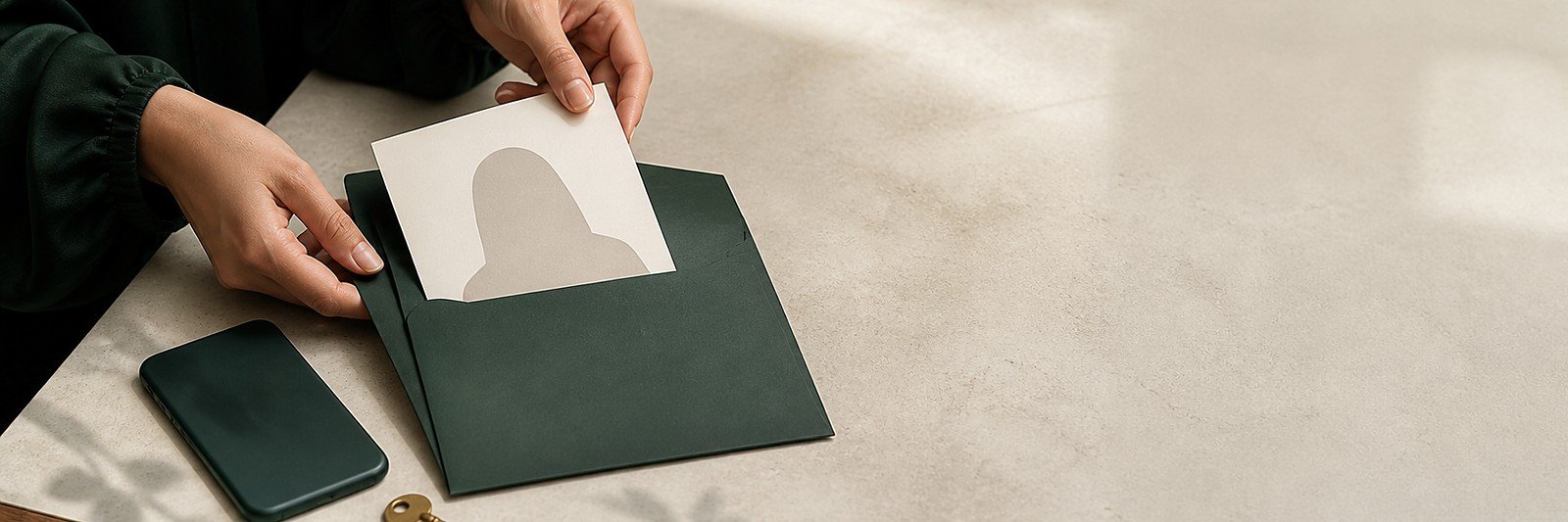
You can also use a blurred photo that is revealed only with your consent. Any change to a visibility level takes effect immediately and cancels all earlier access.
When to reveal your photo
There is no moment that is right for everyone, but some signs make the decision safer: the conversation has moved beyond pleasantries to serious questions, you have confirmed the other person's seriousness and circumstances, and your family knows about it if that reassures you. Reveal the photo to one specific person by individual permission, not to everyone you accept.
If you feel pressured — "I can't continue without a photo", or repeated insistence — the pressure itself is reason enough to slow down.
What should not appear in the photo
Even a photo you choose to reveal can say more than you intend. Before uploading it, look at the background:
- A street sign, a building name or a landmark that pinpoints where you live.
- An employer's logo or an ID badge.
- Children or family members who have not agreed to appear.
- Reflections in glass or mirrors showing things you did not notice.
And choose a photo you have not posted anywhere else online, because a reverse image search can link it to your other accounts and your full name.
If your photo is misused
Do not negotiate with anyone threatening you, do not pay, and do not delete the evidence. Take screenshots of the conversation and the account, and use the reporting tool on the platform immediately — reports are logged, reviewed and acted on. If it goes beyond the platform into a real threat, the relevant authorities in your country are the place to turn, and there is nothing shameful in asking for help.
In short: your photo is yours, and the default is that it stays that way. Every step after that is one you take yourself, by your own choice, for someone you choose.